Is Chopstick Making in Tokyo Worth It? An Honest Look
Is chopstick making in Tokyo worth it? Yes, if you want a genuine, usable souvenir you shaped with your own hands in about an hour, and no, if you're hoping for a full afternoon of craft or a dramatic factory tour. I have sat at these benches more times than I can count for a job that involves visiting Tokyo's small studios, and the honest answer sits somewhere between a novelty photo op and a real woodworking lesson. It is closer to the latter than most visitors expect. Below I break down what an hour actually costs across the city's workshops, what you walk away with, the parts nobody puts in the marketing copy, and who should spend that hour elsewhere. If you decide it belongs on your Tokyo itinerary, you can compare every chopstick-making workshop we track in one place.
Quick answer
Yes, for most first-time visitors. Chopstick making in Tokyo runs about one hour, costs roughly $23 to $34 per person at the central studios or as little as $3 to $6 at the two Asakusa workshops, and you leave with a hand-planed pair you actually use. Skip it only if you have no interest in a slow, quiet craft or you are trying to pack in a full afternoon of sightseeing instead.
Key takeaways
- Real prices run from about $3 at the Asakusa studios up to roughly $34 for the Shinjuku ZEN class, both current as of August 2026
- The single best reason to go: you take home a pair of chopsticks you shaped yourself, the same day, no shipping wait
- The biggest honest downside: it is one quiet hour at a bench, not a spectacle, and premium wood costs extra almost everywhere
- Skip it if you want a group activity with a show, or if your itinerary has no room for a calm indoor hour
- Best timing: mornings and weekdays keep the small studios uncrowded and the popular Asakusa slots easier to book
- Book two to three days ahead in high season; the Asakusa workshop with 1,111 reviews sells out its best morning slots first
The Short Answer
Chopstick making in Tokyo earns its place on an itinerary when you go in expecting exactly what it is: a one-hour hands-on craft class where you plane, sand and oil your own pair of chopsticks under a teacher's eye, not a theatrical demonstration and not a full-day workshop. Every studio I have visited runs to roughly the same shape, whether it sits on the tenth floor of a Shinjuku office tower or in a small artisan-run shop near Senso-ji in Asakusa. My rule of thumb after doing this at four different studios:
- Worth it if: you want a real souvenir that is not a keychain, something you made rather than bought
- Worth it if: you have one spare hour on a rainy afternoon or between two bigger plans in central Tokyo
- Worth it if: you enjoy slow, tactile work and don't mind getting sawdust on your hands for a while
- Skip it if: your whole day is already booked and an hour indoors feels like a loss, not a gain
- Skip it if: you specifically want a group spectacle, a demonstration, or something photogenic for a crowd rather than quiet individual focus
- Skip it if: a plain pair of chopsticks holds no appeal to you even as a handmade object; some travelers genuinely won't care
What It Actually Costs
Prices below are per person, verified against each studio's live listing in late July 2026 and converted at roughly ¥157 to the dollar. The scraped headline prices you sometimes see on aggregator pages ($3 to $11) are misleading: they mix a genuinely low promotional price at the Asakusa studios with truncated figures for the rest. The real prices at the central studios run considerably higher.
| Option | Typical price | Duration | Best for |
|---|---|---|---|
| Asakusa workshop | from $3-6 | 1 hour | Budget travelers, first-timers, families |
| Engraving workshop | from $3-6 | 1 hour | A personalised keepsake with your name |
| Artisan-led Taito workshop | from $25 | 1 hour | Hands-on guidance from a working craftsman |
| Ginza workshop | from $25 | 1 hour | Pairing the class with Ginza shopping |
| Shibuya workshop | from $23 | 1 hour | Step-free access near Shibuya Crossing |
| Shinjuku ZEN class | from $34 | 1 hour | Central location, the most-reviewed class in Tokyo, 5.0★ from 3,855 reviews |
The spread comes down to studio format more than anything else. The two Asakusa studios run a leaner, lower-overhead class and price accordingly; the studios in Shinjuku, Ginza and Taito include more staff attention and, in Shinjuku's case, a central tenth-floor location that costs more to run. Wood choice is the other real lever: three included woods is standard, and premium species like Yakusugi cedar or Pink Ivory at the Ginza studio's 26-wood selection carry a surcharge on top of any of these base prices.
For the full price-by-price breakdown and the extra costs people forget to budget, see what chopstick making in Tokyo really costs.
Worth noting for anyone comparing platforms before booking: the low $3-6 figures belong specifically to the two Asakusa-area listings, not to every workshop on this list. If a comparison site shows every studio in this city at $3-11, that number has been flattened somewhere along the way; the studios in Shinjuku, Ginza and Taito genuinely run closer to $23-34. I would rather tell you that plainly than let you show up expecting a $4 class at a $30 studio.
What You Get for the Money
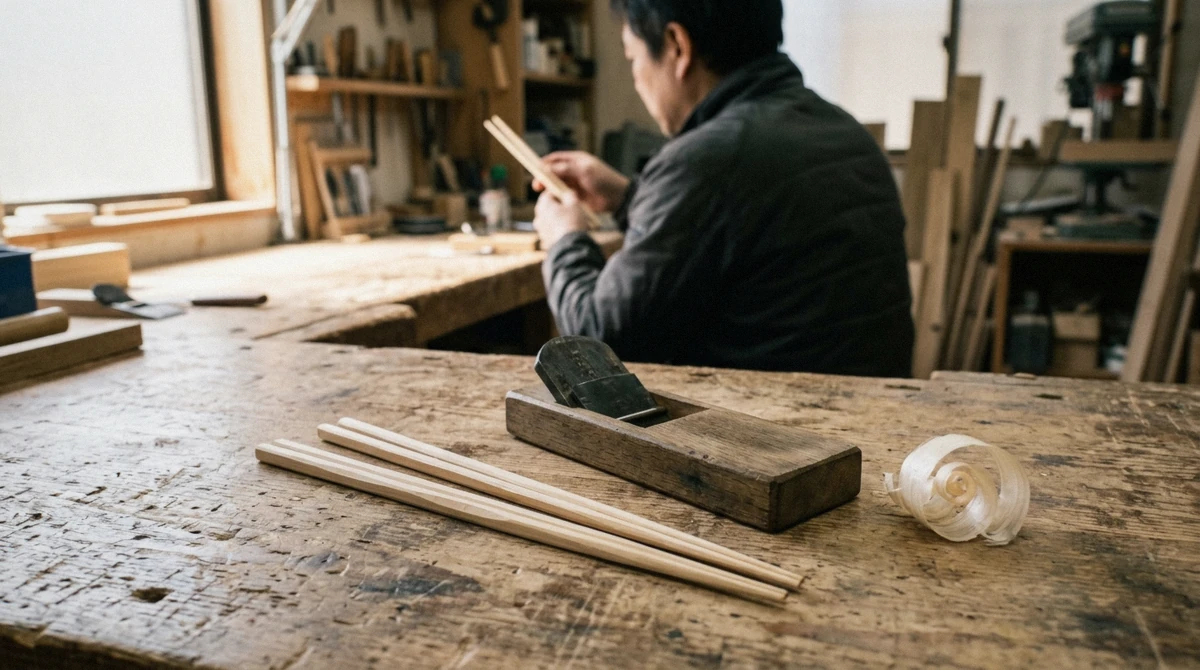
We sit down at a low workbench with a rough, roughly squared wood blank already cut to length. The teacher clamps it into a simple wooden jig, and the first job is watching a demonstration pass with the kanna, the traditional Japanese hand plane, before trying it ourselves. The blade takes off paper-thin curls of wood in one smooth pull, and the goal is a four-sided taper: thick enough at the grip end to hold comfortably, thin enough at the tip to pick up a single grain of rice.
- A clamped blank in a wooden jig, planed by hand with a kanna until the taper is even on all four sides
- Fine, paper-thin shavings falling onto the bench as the shape comes through, usually the part people photograph most
- A sanding pass to soften the tips and round the corners, working through a couple of grits by hand
- A final oil coat rubbed in by hand, which brings out the wood grain and seals the surface
- Roughly 45 to 60 minutes total, start to finish, and you take the pair home the same day, no shipping wait
What's included in the base price is standard tools, a workbench seat, staff instruction in English at every studio we cover, and usually three wood options with no surcharge. What is typically not included: premium wood species (the Ginza studio's Yakusugi cedar and Pink Ivory carry an extra charge), name engraving (about ¥1,100, roughly $7 as of August 2026, at studios that offer it), and, at some studios, a second pair if you want a matching set for a partner. If you want the step-by-step version of the hour with clock times and what to expect walking in, our first-time chopstick making guide walks the whole bench sequence in more detail than fits here.
The kanna itself is worth a moment of attention on its own. It is a low-angle Japanese hand plane, pulled toward the body rather than pushed away, the opposite motion from the Western planes most visitors have seen if they have used one at all. The blade is set shallow enough that a good pass takes off a shaving thin enough to read a newspaper through, and the teacher's first demonstration pass is usually the most impressive minute of the whole hour, precisely because your own first attempt rarely matches it.
That gap between the demonstration and your own first cut is normal, not a sign you are doing it wrong, and every teacher I have watched corrects grip and angle rather than taking the tool back and finishing it for you.
The Honest Downsides
This is the part the booking pages skip, so here is what I would tell a friend before they paid for a slot.
- It is one hour, not a day. If you are picturing an immersive craft retreat, recalibrate; this is a focused single hour and the class ends the moment your pair is finished, oil and all
- Wood upgrades cost extra almost everywhere. Three included woods is the norm, and the interesting, patterned species (Yakusugi cedar, Pink Ivory, the darker hardwoods) sit behind a surcharge at every studio that stocks them
- The popular slots sell out. The Asakusa workshop alone has 1,111 reviews, which tells you how often its best morning times fill first, especially on weekends
- The rooms are small. This is a craft class in a genuine small studio, not a purpose-built tourist attraction, so groups above ten or twelve feel cramped and the pace slows
- It is a craft class, not a factory tour. Nobody is walking you through a full traditional workshop with dozens of artisans; you are at one bench, with one teacher, making one pair
None of these are reasons to skip the hour outright, but they are reasons to set expectations before you book. The travelers who leave disappointed are almost always the ones who expected either a bargain-bin souvenir shop experience or a full artisan apprenticeship, and got the honest middle ground instead: a real, unhurried hour of guided handwork that produces one plain, useful object.
Workshop vs Buying Chopsticks in a Shop
The comparison worth making before you book: paying to make a pair yourself versus simply buying a finished pair at a specialist chopstick shop.
| Workshop | Buying at Ginza Natsuno | |
|---|---|---|
| Price | $3-34 depending on studio | House pairs from ¥3,300 (about $21) |
| Time | About one hour | A few minutes browsing |
| Selection | 3-26 wood types depending on studio | 3,000+ chopstick varieties, 1,000+ rests |
| What you keep | A pair you shaped yourself, imperfections included | A factory or master-crafted finished pair |
| Top tier available | Premium wood surcharge, engraving ~¥1,100 | Wakasa-nuri lacquered sets ¥70,400; snakewood gold/silver inlay ¥91,800 |
Ginza Natsuno, near Ginza Station, is Japan's largest chopstick dealer and the fair benchmark for what a shop-bought pair actually costs. A workshop pair will never match a Wakasa-nuri lacquer finish, but it beats a bought pair on the one thing a shop can't sell you: the story of having planed it yourself. For the full souvenir-value math against Natsuno's price tiers, see handmade chopsticks in Tokyo as a souvenir.
I don't think this is really an either-or choice. Most travelers who take a workshop still end up browsing a shop like Natsuno afterward, once they understand what separates a ¥3,300 house pair from a ¥91,800 snakewood set with gold and silver inlay. Making your own pair first is, in a way, the cheapest possible education in what you're looking at on those shelves: you have felt how much work goes into even a plain, unlacquered pair, so the price difference between that and a master-lacquered set stops being abstract.
Who Should Do It, and Who Should Skip It
If you are a family with a child under 9
do it, with an adult seated at the bench; most studios require adult supervision at that age and manage older kids fine on their own
If you are a couple wanting a joint souvenir
do it; sit side by side and make a matching pair in the same hour
If you have one spare morning and no fixed plan
do it; an hour indoors adds a craft experience without derailing a packed day
If you are on a one-day Tokyo stopover
skip it; an hour is a real commitment against a single day, spend it on the sights you can't get anywhere else
If you are hoping for a group show or demonstration
skip it; this is quiet, individual bench work, not a performance, and the wrong expectation is the main source of disappointment
How to Book Without Overpaying
Book two to three days ahead for a weekday slot and up to a week ahead for weekend mornings, since the busiest studios fill their best hours first. Every workshop on this list offers free cancellation up to 24 hours before the start time, which matters more than it sounds: Tokyo itineraries shift, and a cancellable slot means you are not out the money if plans change.
For first-timers who want the calmest introduction, the Asakusa workshop pairs well with a Senso-ji visit and keeps the price low. Anyone who wants their initials on the finished pair should look at the engraving workshop. And if you want the most reviewed, most central option, the Shinjuku ZEN class is a five-minute walk from Shinjuku-Nishiguchi Station.
You can compare every chopstick-making class in Tokyo side by side before choosing, and if nerves about your first time at the plane are holding you back, our first-time guide covers exactly what happens minute by minute.
Frequently Asked Questions
Do I need to pay for wood upgrades, or is standard wood included?
Standard wood is included in every base price on this list, usually with about three species to pick from at no extra charge. Premium species, like the Yakusugi cedar and Pink Ivory at the Ginza studio's 26-wood selection, carry a surcharge on top of the listed price.
Can I make chopsticks with the wrong dominant hand, or is the class right-handed only?
Teachers work one-on-one and adjust the jig angle for left-handed students on request. It is worth mentioning it when you book so the studio can seat you accordingly, since benches are often arranged for right-handed use by default.
Are the chopsticks I make dishwasher safe?
No. A hand-oiled, unfinished pair should be hand washed and dried promptly, the same care any natural-wood chopstick needs. Treat them like a kitchen tool you actually use, not a display piece, and they will hold up for years.
Can I carry my finished chopsticks in carry-on luggage?
Yes. A finished pair of wooden chopsticks with rounded tips carries in checked or carry-on luggage without issue on international flights; they are a household utensil, not a restricted item.
Will I share a workbench with a stranger, or do I get my own space?
Most studios seat each participant, or each couple, at their own bench or clamp station, even in a small shared room. You are not sharing tools mid-task with someone outside your booking.
Is there a kids' price, or do children pay the same as adults?
Pricing varies by studio and is not always broken out separately for children; check the specific listing at booking. Most studios welcome children from around age 9 with an accompanying adult, younger with extra supervision.
I still have the first pair I made, a little uneven at the tips, the taper slightly off on one side. That unevenness is the honest point of the whole exercise: nobody leaves a Tokyo chopstick workshop with factory-perfect symmetry, and nobody should expect to. What you leave with is a pair that fits your own hand, made in an hour you spent paying attention instead of scrolling past another temple photo.
If that sounds like a fair trade for $3 to $34 and sixty minutes, it is worth it. If it sounds like an odd way to spend a Tokyo afternoon, spend the hour somewhere else and don't feel you missed anything essential.